Murder Mystery Puzzle Games: Types & Clues
Published July 16, 2026 · 5 min read
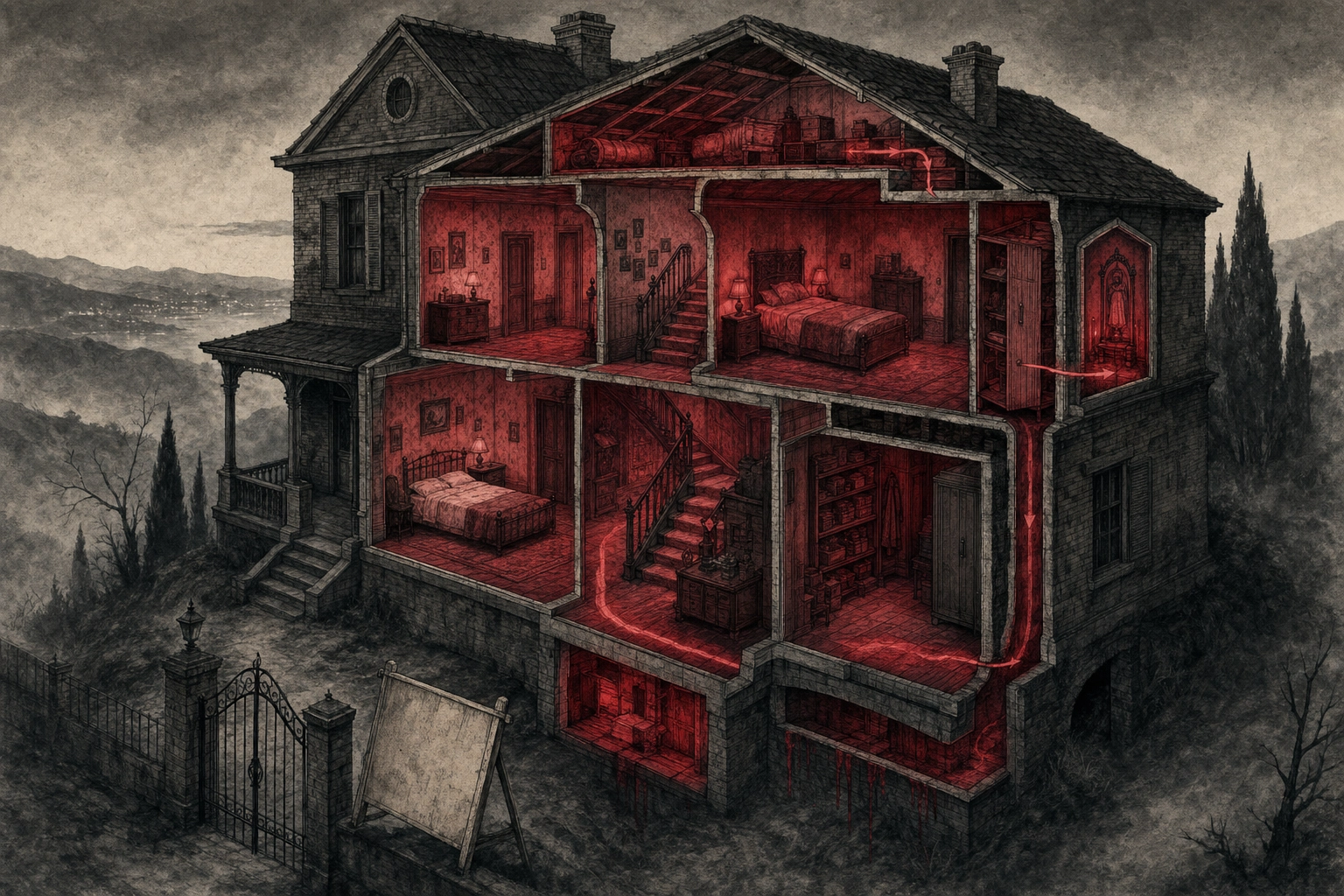
The best murder mystery puzzle games do more than hide a culprit behind a list of suspects. They give you a system to reconstruct: a timeline that cannot fit every alibi, a logic grid that eliminates impossible combinations, a room whose geometry exposes a route, or a set of documents that becomes meaningful only when compared.
Choose by puzzle type first, then by difficulty. Pick timeline and alibi puzzles if you enjoy sequencing events; logic-grid deduction if you like explicit constraints; spatial or locked-room mysteries if you think in maps; document and cipher cases if you enjoy close reading; and AI interview mysteries if you want conversation to function as a flexible logic tool. Puzzle density tells you how often the game asks for a discrete deduction. Difficulty tells you how demanding those deductions are. They are not the same.
The puzzle mystery subtype map
| Puzzle subtype | What you reconstruct | Typical evidence | Best fit | Main risk |
|---|---|---|---|---|
| Timeline and alibi | Who could be where, and when | Timestamps, travel times, sightings, calls | Sequence-minded players | Too many unanchored times |
| Logic-grid and deduction | Which combinations remain possible | Exclusive claims, categories, constraints | Players who like elimination | Mechanical busywork |
| Spatial and locked-room | How access, sightlines, or movement worked | Floor plans, doors, dimensions, object positions | Visual and diagram-based thinkers | A hidden mechanism with no clue |
| Document and cipher | What records imply when decoded or compared | Letters, logs, receipts, marginalia, codes | Close readers and pattern hunters | Cipher difficulty replacing mystery logic |
| AI interview as logic tool | Which claims survive follow-up questions | Testimony, contradictions, knowledge boundaries | Players who think by questioning | Improvised answers changing the truth |
Many mystery puzzle games online mix several rows. The useful question is not “Does this game contain puzzles?” but “Which form of reasoning carries the solution?” A case may include a coded note, yet still be fundamentally a timeline mystery if the decoded message only establishes when someone left.
Timeline and alibi puzzles
Timeline puzzles turn the investigation into a sequence of constrained events. You collect fixed points—the last confirmed sighting, a train departure, a logged door opening—and place less reliable claims around them. The central pleasure is discovering that two accounts cannot both be true.
A strong timeline case gives you anchors and meaningful travel limits. If a suspect claims to cross the house in two minutes, the map should let you test that claim. If a clock is wrong, another clue should establish the offset. Uncertainty can be fair, but arbitrary timestamps are not.
This subtype suits players who naturally write “before,” “after,” and “during” beside every clue. It can become demanding when parallel crimes overlap or when a witness reports an event correctly but assigns it the wrong time. The timeline reconstruction guide explains the underlying model; it is a technique resource, while this article helps you decide whether that model is the kind of puzzle you want.
Snowbound Pursuit is the relevant case choice when you want a timeline-driven investigation in which several events must be separated rather than folded into one explanation.
Logic-grid and constraint deduction
Logic-grid mysteries give you statements that rule combinations in or out: the person in the library was not carrying the key; the caller arrived after the doctor; only one suspect could access both locations. You may never see a literal grid on screen, but the reasoning is the same.
Good constraint design has three qualities:
- Each rule has a clear meaning.
- Several rules interact to produce a new fact.
- The final deduction connects back to motive, method, or opportunity.
Weak design asks you to complete a detached matching exercise and then hands over a clue unrelated to the crime. Strong design makes the grid itself investigative. Learning that a suspect could not have used the west stairs should change your theory of access, not merely unlock the next page.
Choose this subtype if you enjoy certainty through elimination. Avoid a very dense version if you dislike maintaining notes, because remembered constraints quickly blur into assumptions.
Spatial and locked-room puzzles
Spatial mysteries treat the setting as evidence. Door directions, windows, sightlines, missing floor area, object placement, and movement routes can all disprove testimony. A locked-room problem is one important branch of this subtype: it asks how an apparently impossible entry, exit, or action occurred.
Not every spatial mystery is a locked-room mystery. A case can depend on who could see a corridor without presenting a sealed chamber at all. Conversely, a locked room can rely on timing, identity, or language rather than architecture. If the impossible enclosure is specifically what you want, use the focused locked-room puzzles guide.
Fair spatial design lets you inspect or infer the decisive feature before accusing. A passage, movable wall, or unusual lock should leave a footprint in measurements, testimony, wear, sound, or another observable clue. “There was a secret door that nobody could discover” is a reveal, not a deduction.
The Womb House is the natural choice for players who want architecture, room relationships, and physical space to carry substantial logical weight.
Document and cipher mysteries
Document puzzles ask you to compare records rather than accept each one alone. A receipt may challenge an alibi; two diary entries may use incompatible names; a maintenance log may explain why a room was accessible. The deduction comes from provenance, wording, omission, or conflict.
Ciphers can add texture, but a cipher should serve evidence. Decoding a phrase is satisfying when the result identifies a meeting place, corrects a date, or exposes who possessed certain knowledge. A long substitution exercise that only says “look under the desk” tests patience more than detective reasoning.
Before choosing a document-heavy case, ask:
- Does decoding reveal evidence or merely navigation?
- Can the code be solved from information inside the case?
- Will comparing documents matter after they are read?
- Is there an accessible hint path if transcription is not your idea of fun?
The best document mysteries reward interpretation after extraction. Getting the plaintext should begin the deduction, not end it.
AI interviews as a logic tool
AI suspect interviews can make an authored puzzle less rigid. Instead of selecting “ask about alibi,” you can request a minute-by-minute account, challenge a word choice, or ask who could verify a claim. Conversation becomes a way to query the case model.
For this to remain a fair puzzle, the underlying truth must stay fixed. An answer can be phrased flexibly, and a suspect can lie according to the authored role, but the culprit, timeline, and evidence cannot change to match the player's theory. Searchable scenes also matter because testimony alone should not be the sole source of truth.
Missing Witness offers authored, fixed-solution browser cases with AI suspect interviews and searchable scenes. Its free case can be played from start to finish signed out, with no question limit; the other cases need a paid unlock. Play is natively solo, although couples or groups can share a screen and debate what to ask next. Browse the case library when that combination of open questioning and fixed evidence appeals to you.
Puzzle density is not difficulty
Puzzle density is the frequency and variety of deduction tasks. Difficulty is the mental load required to solve them. A case can be dense but easy—many short, explicit deductions—or sparse but hard, with one deeply interdependent reconstruction.
| Experience | Puzzle density | Difficulty | Likely feel |
|---|---|---|---|
| Guided sampler | Low | Low | Story-forward, occasional deduction |
| Puzzle trail | High | Low to medium | Frequent wins and steady progression |
| Classic whodunit | Medium | Medium | Investigation balanced with narrative |
| Deep reconstruction | Low to medium | High | Long thinking around a few central models |
| Puzzle gauntlet | High | High | Constant note-taking and synthesis |
Use the murder mystery difficulty guide to assess suspect count, clue dependency, and final-answer depth. Then separately ask how continuously you want to solve. More puzzles do not automatically make a better or harder game.
A quick chooser for online mystery solving games
Before opening a case, use this checklist:
- I want to arrange events: choose timeline and alibi.
- I want clean eliminations: choose logic-grid deduction.
- I want to sketch rooms: choose spatial or locked-room.
- I want to inspect wording and records: choose document puzzles.
- I want to invent my own questions: choose fixed-truth AI interviews.
- I want frequent small breakthroughs: choose higher puzzle density.
- I want one demanding central problem: choose lower-density, higher-difficulty reconstruction.
Also decide whether you want a puzzle mystery or a general detective-skills lesson. The how to solve a murder mystery guide teaches tactics such as testing opportunity and contradictions. This page maps game structures so you can select the experience before playing. Neither replaces the other.
Fair clues matter in every subtype
Whatever form the puzzle takes, the decisive chain should be available before the final accusation. Fair does not mean obvious. It means the game gives you enough information to form and test the correct theory without requiring an unannounced rule, an inaccessible object, or a fact introduced only during the reveal.
Look for clues that advance the correct model and explain a plausible alternative. A timeline might use a delayed message; a spatial case, a revealing measurement; an interview, a claim whose meaning changes after physical evidence establishes what the speaker knew.
Frequently asked questions
What are murder mystery puzzle games?
They are investigations in which solving depends on structured reasoning, not only selecting a suspect. Common structures include timelines, constraint grids, spatial models, document comparison, ciphers tied to evidence, and contradiction testing through interviews.
Which puzzle subtype is best for beginners?
Timeline puzzles with a few firm anchors and light logic-grid deductions are usually easiest to read. Beginners should favor moderate density and explicit evidence over a case that combines maps, codes, and several overlapping sequences.
Are locked-room mysteries always spatial puzzles?
No. Many rely on architecture or access, but an impossible crime can also turn on timing, identity, wording, or an incorrect assumption. Choose a spatial case only when maps and movement are part of the appeal.
Do ciphers make a murder mystery harder?
They can increase effort without increasing deductive depth. A fair cipher uses information supplied in the case and reveals evidence that matters. Lengthy decoding with no effect on the theory is puzzle volume, not meaningful difficulty.
Can AI interviews be fair-play puzzles?
Yes, when the case has a fixed authored truth and answers remain constrained by it. Flexible language should help you examine testimony; it should not let the game rewrite the killer or invent a decisive clue after your accusation.
Ready to choose by reasoning style rather than cover art? Browse all Missing Witness cases, compare their public themes and difficulty ratings, and start with the reasoning style that sounds most appealing.