What Is a Locked Room Mystery? 7 Ways to Fake an Impossible Crime
Published August 14, 2026 · 6 min read
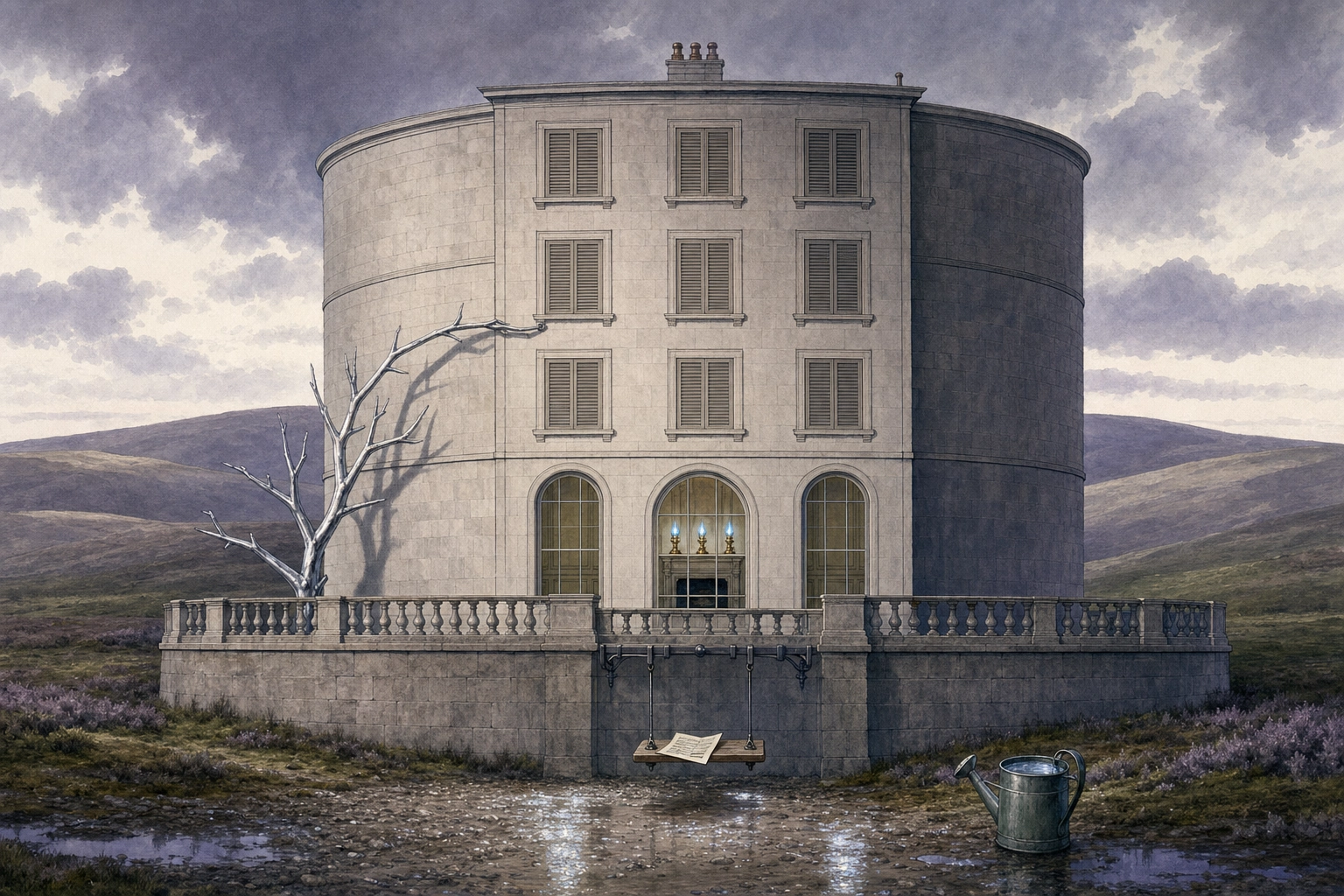
A locked room mystery is a crime that appears to be impossible: a body inside a space that nobody could have entered or left. The door is bolted from the inside, the windows are painted shut or watched, the snow outside is unmarked — and yet someone died by another person's hand.
The genre's real subject isn't the room. It's the gap between what a scene appears to prove and what it actually proves. The room is only the most dramatic way to stage that gap.
The strict definition (and the loose one)
Purists use "locked room" for a literally sealed space: the door locked from within, the key still inside, no other exit. The broader and more common usage is impossible crime — any situation where the physical circumstances seem to rule out every suspect.
That wider family includes:
- The sealed room — bolted door, key inside, no exit.
- The watched room — an unlocked door under continuous observation, which is often harder to beat than a bolt.
- The unmarked snow or sand — a body with no footprints leading to or from it.
- The closed circle — an island, a train, a snowed-in manor. Everyone is a suspect because nobody else could be.
- The impossible disappearance — a person, a body, or an object that leaves a space it could not have left.
Agatha Christie's And Then There Were None is a closed-circle novel rather than a sealed-room one; Murder on the Orient Express is a closed circle on rails. Both belong to the same tradition even though neither hinges on a bolted door.
Where the form comes from
Edgar Allan Poe's "The Murders in the Rue Morgue" (1841) is the usual starting point — two women killed in a fourth-floor room in Paris, apparently sealed, with C. Auguste Dupin working out how it was reached. Israel Zangwill's The Big Bow Mystery (1892) built a full novel on the premise, and Gaston Leroux's The Mystery of the Yellow Room (1907) turned it into a set piece that mystery writers have been answering ever since.
The genre's central text is John Dickson Carr's The Hollow Man (published in the United States as The Three Coffins, 1935). Its detective, Dr Gideon Fell, stops the plot to deliver what readers call the Locked Room Lecture — an explicit taxonomy of how sealed-room murders are done, delivered to the reader inside the novel that is using one of them. It remains the most quoted piece of criticism the mystery genre has produced, partly because Carr had the nerve to hand the audience the answer key mid-book and still fool them.
The form never really died. It was rebuilt in Japan as honkaku ("orthodox") mystery — a movement explicitly committed to fair-play puzzle construction, where the impossible crime is the main event and the reader is formally invited to solve it. That lineage runs through writers like Seishi Yokomizo and Soji Shimada into the contemporary novels and comics that keep the impossible-crime plot in wide circulation across East Asia. It's also why the Chinese script murder games known as jubensha lean so heavily on sealed rooms and architectural tricks: that audience grew up on the form.
The seven ways an impossible crime is faked
Carr's lecture sorted the solutions into categories; later critics have expanded and reshuffled them. Here is the practical version — the seven mechanisms that account for nearly every locked room you will ever meet, in books or in games.
1. The room was never sealed
The simplest and most common. There is an exit the investigation didn't count: a second door behind a wardrobe, a serving hatch, a shared chimney, a window that looks painted shut and isn't, a lock that can be turned from outside with the right tool.
This category includes every trick where the lock itself is defeated — string-and-pin devices that shoot a bolt home from the corridor, keys turned through the keyhole with pliers, hinges lifted and replaced. Carr catalogued these in detail precisely so writers would stop leaning on them.
How to spot it as a player: measure the room. If the described dimensions don't match the building, the missing volume is the answer. That's the whole engine of Womb House — a villa listed below its own footprint.
2. The death happened before the room was sealed
The victim was attacked outside, or earlier, and reached the room under their own power. Delayed-action poisons, slow internal bleeding, and injuries the victim didn't understand all put a living person into a room they then locked themselves.
The room is genuine. The timing is the lie.
How to spot it: look for a medical or forensic estimate that's presented as narrower than it could be. If time of death is a range and everyone is arguing about the middle of it, check the edges.
3. The room was sealed after the death
The reverse. The killer leaves, then makes the room impossible from outside — or an accomplice, or the first person to "discover" the body, does it for them. The most elegant version is the discoverer who breaks the door down, is briefly alone with the scene, and bolts it from inside during the two seconds nobody is watching them.
How to spot it: the person who found the body is structurally the most powerful suspect in any impossible crime, because they are the only one with a legitimate reason to have touched everything.
4. It wasn't murder
Suicide staged to look like murder — usually to frame someone, or to defeat an insurance clause. Or a genuine accident that a frightened third party then dressed up. Or a murder committed by the victim on themselves via a device that the killer supplied but never operated.
Carr's lecture gives this category real weight, and it's the one modern readers under-weight most, because we assume the corpse's death was somebody else's decision.
How to spot it: ask who benefits from the interpretation rather than from the death. If a fortune moves depending on whether it reads as suicide, the staging may be the whole crime.
5. The killer never entered
A weapon operated at distance: a shot through a gap, a mechanism triggered by the victim, poison delivered in advance, an animal, an object dropped from above, a device that destroys itself. The room stays sealed because nothing but the cause of death ever crossed the threshold.
This is the category with the strictest fairness requirement. Ronald Knox's rules for detective fiction specifically ruled out undiscovered poisons and gadgets that need a long scientific explanation, exactly because this mechanism can be abused into un-guessability.
How to spot it: look for anything in the room that arrived recently and that the victim was expected to touch, drink, wind, light, or open.
6. The scene isn't where you think it is
The body was moved. The room you're looking at is not the room where the death happened, or the geography has been misrepresented — floors renumbered, doors repainted, rooms swapped, a corridor that isn't the length everyone assumes.
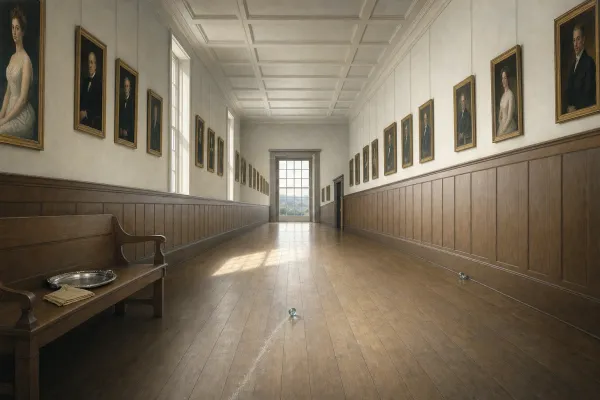
This is the most architecturally satisfying family and the hardest to write fairly, because it requires the reader to have been given the true layout in a form they didn't process. Magic Square Manor and The House That Lies both live here: in one, the floors never turned but the numbers did; in the other, a gallery reads as level while a marble keeps rolling north.
How to spot it: draw the map yourself from the text, rather than trusting any map you're handed. If two descriptions of the same space can't both be true, you've found it.
7. The witnesses are the lock
There is no physical seal at all — the impossibility exists only because people say so. A corridor "under constant observation" is only sealed if the watcher is honest, awake, and where they claim. Two witnesses who agree can manufacture an impossible crime out of an ordinary one.
Carr treated this as its own category, and it is the one that ages best, because it requires no gadgets and leaves no trace. The Perfect Witness turns on exactly this: evidence that never lies, written by hand.
How to spot it: for every element of the impossibility, name the person whose word establishes it. If a single account is holding up the whole puzzle, the puzzle is that account.
Why the form still works
A locked room does something no other mystery structure does: it makes the reader doubt the frame instead of the cast. In an ordinary whodunit you sort six people by means, motive and opportunity. In an impossible crime you first have to establish that a crime could happen at all — and that forces a different, better kind of attention.
It's also the fairest possible contract between writer and reader. The scene is fully described. Nothing is hidden. The trick is entirely in what you assumed while reading a true description. When it lands, the reveal doesn't feel like new information; it feels like the same information, seen properly. That's the effect the whole genre is chasing, and the sealed room is the purest machine for producing it.
Where to start reading
If you want the canon, the sensible order is:
- Poe, "The Murders in the Rue Morgue" (1841) — short, foundational, and still surprising in how it handles the exit.
- Gaston Leroux, The Mystery of the Yellow Room (1907) — the novel that made the sealed room a formal challenge.
- John Dickson Carr, The Hollow Man / The Three Coffins (1935) — the Locked Room Lecture, plus a puzzle that survives being told the answer key.
- Agatha Christie, And Then There Were None (1939) — the closed circle taken to its limit.
For the modern Japanese branch, look for the honkaku label, which publishers use specifically to signal that the puzzle is solvable and the reader is meant to try. The Wikipedia entry on the locked-room mystery keeps a reasonable list of further titles if you want to go deeper.
Frequently asked questions
What's the difference between a locked room mystery and a closed circle mystery?
A locked room asks how — the crime looks physically impossible. A closed circle asks who — the suspect list is finite and everyone is trapped together. Many novels are both. Murder on the Orient Express is a closed circle; The Hollow Man is a locked room; And Then There Were None is a closed circle that repeatedly stages impossible-looking deaths.
Are locked room mysteries always solvable by the reader?
They're meant to be. That's the genre's whole claim. The fair-play tradition — Knox's rules, Van Dine's, and the Japanese honkaku movement — exists to guarantee the reader has every fact the detective has. A locked room that resolves with an unmentioned secret passage or a poison nobody has heard of is considered a failure by the form's own standards. We break down the same test for games in five checks for a fair-play mystery.
Why is it always a bolted door?
It isn't, and the best examples usually aren't. Unmarked snow, a watched corridor, a body on an island, a room full of witnesses — all produce the same effect with less machinery. The bolted door is just the most legible image, so it became the shorthand.
Can you play a locked room mystery rather than read one?
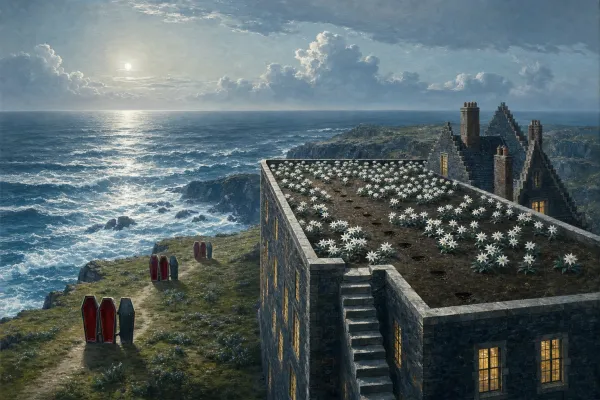
Yes, and it changes the experience: instead of waiting for the detective's explanation you have to produce it yourself. Browse the online cases for impossible-crime scenarios you can investigate directly — question suspects in your own words, search the scene, and submit the mechanism as part of your accusation. Eight Coffins (one trail up, none down), The Warren (a door that opened two hours after the body was found), and The Vigil (six lamps went dark, one of them a lie) are the closest to the classical form.