What Is Jubensha? Inside China's Script Murder Games
Published August 14, 2026 · 6 min read
Jubensha (剧本杀, jùběnshā) is China's script murder game: a group of four to nine people, a booklet each, a host, and four to six hours in a themed room reconstructing a crime. One of the players is the killer. They know it, and their job is to survive the vote.
The name is literal — 剧本 (jùběn) is "script" and 杀 (shā) is "kill". English speakers usually render it as "script murder" or "scripted mystery". It is not a translation of the Western murder mystery party, and treating it as one is why most first-time Western players are surprised by how long, how structured, and how emotionally heavy a session can be.
How a session actually runs
The format is standardised enough that you can walk into a shop in any Chinese city and know the shape of the evening.
1. Choosing a script (选本). Groups pick by genre and difficulty from a shop's library — often hundreds of titles. Player count is fixed by the script, not the group, so a six-player script needs exactly six.
2. Character assignment and reading (读本). Each player receives their own booklet: backstory, relationships, secrets, objectives, and what they personally know about the night in question. These run long — 5 to 15 pages is normal, and hardcore scripts run considerably longer. Everyone reads in silence for 30 to 60 minutes. This is unlike anything in a Western party kit, where a character brief is typically one page.
Crucially, the killer's booklet tells them they did it. They are not discovering it alongside everyone else; they spend the whole session constructing a defence.
3. Self-introduction (自我介绍). Each player presents their character to the table — a mix of what's true, what's edited, and what's outright invented. The killer's introduction is their opening lie, and good players build the rest of the session on it.
4. Clue searching (搜证). Rounds of physical or card-based evidence collection. Players choose where to search, retrieve clue cards, and decide whether to share what they find. Withholding a clue is legal and often correct — a clue that clears you may also expose your affair, your theft, or your other secret.
5. Public and private discussion (公聊 / 私聊). Alternating open debate at the table and timed private conversations, usually two people stepping outside. The private rounds are where alliances form and where the killer does most of their real work.
6. Voting (投票). Everyone names a suspect. The killer wins by surviving the vote; the others win by convicting correctly. Some scripts add individual objectives, so a player can lose the vote and still complete their own goals.
7. The reveal (复盘). The host walks the true sequence of events, usually in full narrative form. This is treated as the emotional payoff, not an afterthought, and in story-heavy scripts it routinely runs 30 minutes or more.
Total: four to six hours for a standard script, longer for hardcore ones.
The host is the format
Every session has a 主持人 or DM — a host who paces the rounds, releases clues, manages timers, plays non-player characters, and delivers the reveal. In a commercial shop this is a paid job, and a good host is the difference between a great session and five hours of confusion.
This is a structural difference from Western party kits, which are designed so the host is also a player, or so the box runs itself. Jubensha assumes facilitation. It's part of why the format built an industry of physical venues rather than boxed products sold for home use.
The genres
Jubensha players sort scripts into recognised categories, and knowing them is how you avoid picking the wrong evening:
- 硬核推理 (hardcore reasoning) — genuine deduction. Timetables, floor plans, physical mechanisms, locked rooms. The closest thing to a Golden Age puzzle novel you can play. These are notoriously difficult, and shops warn beginners off them.
- 情感本 (emotional scripts) — the crime is a frame for a story about family, love, loss or memory. The reveal is designed to make players cry, and it regularly does. This category has no real Western equivalent and is a major reason the format took hold.
- 恐怖本 (horror) — atmosphere, jump scares, sometimes actors and darkened rooms.
- 阵营本 (faction scripts) — players belong to competing camps with group objectives. Closer to social deduction games like Werewolf.
- 机制本 (mechanism scripts) — built around a system: a time loop, a memory-wipe, a body swap, an unreliable narrator baked into the rules.
- 欢乐本 (comedy) — light, absurd, good for beginners and work outings.
- 还原本 (reconstruction) — the group's job is to rebuild exactly what happened, in order, with no killer to catch.
A single shop typically stocks all of these. "Which script?" is a longer negotiation than "which restaurant?", and the genre choice sets the tone for the entire evening.
Where it came from
The category name emerged in mainland China around 2016. Two things are usually credited with launching it.
The first is a boxed British murder mystery game, Death Wears White, which circulated in Chinese translation and gave players a template for script-driven play. The second is the television variety show Who's the Murderer (明星大侦探), which put celebrities through exactly this format on screen from 2016 and turned a niche hobby into something millions of people had watched before they ever played it.
From there it became a physical business. Dedicated shops opened in every major city, many with built sets, costumes, lighting and actors playing NPCs. Scripts split into boxed editions (盒装, sold to any shop) and exclusives (城限 / 独家, licensed to one venue in a city — a scarcity model that gave shops a reason to compete on library rather than price). Industry reporting at the peak around 2021 counted venues in the tens of thousands.
The growth didn't last uninterrupted. Pandemic closures hit a business built entirely on people sitting in a room together, and in 2022 Chinese authorities introduced regulation covering script-entertainment venues — content review requirements and restrictions on minors during term time. The market consolidated afterwards. What survived is a mature format with a professional writing scene behind it, which is arguably a better position than the boom.
Jubensha vs the Western murder mystery party
They look adjacent and play completely differently.
| Jubensha | Western party kit | |
|---|---|---|
| Length | 4–6 hours | 2–3 hours |
| Player material | 5–15+ page personal booklet | Usually 1–2 pages |
| Does the killer know? | Yes — they play to deceive | Usually not; the box reveals it |
| Clue delivery | Active searching, contested | Handed out on a schedule |
| Host | Dedicated, usually paid | The party host, also playing |
| Setting | Purpose-built venue with sets | Someone's dining room |
| Emotional register | Often the point — grief, memory, sacrifice | Usually comic |
| Deduction depth | Can be extremely demanding | Generally light |
The single most important row is the third. When the killer knows they're the killer, every conversation in the room is a live contest — you're not collectively assembling a solution, you're being actively worked on by someone who read a different book to you. That one design decision changes the entire texture of the experience, and it's what jubensha players mean when they say Western kits feel like theatre rather than a game.
The comparison with tabletop role-playing games goes the other way: jubensha has no dice, no character creation, no improvised world. The script is fixed, the truth is written before you arrive, and your freedom is in performance and argument rather than in what happens. If you want the analogy, it's a play where the audience has to work out the plot and one actor is lying to them.
Why it's hard to play in English
Interest outside China has grown steadily, and English-language jubensha exists — there are venues in Melbourne, Singapore, London and North America running translated and originally-written scripts. But adoption has been slower than the format's quality deserves, for four reasons.
Translation is expensive and unusually hard. A six-player script is six booklets that must stay consistent with each other. Wordplay clues, name-based clues, and clues that depend on written Chinese characters often can't survive translation at all — a puzzle turning on the components of a character has no English equivalent, so it has to be rebuilt from scratch.
The scripts are culturally embedded. Emotional scripts in particular lean on family structures, historical periods, and social expectations that carry enormous weight for a Chinese audience and land flat without context.
Rights are complicated. Most scripts are commercial products with distribution models designed for the Chinese venue market. Licensing a script for English publication is not a matter of buying a copy.
The format needs a venue and a trained host. Five hours, a room, and a facilitator is a real business, not a box you sell online.
The result is that the most common Western encounter with jubensha is a shortened, boxed adaptation — which loses the searching, the private rounds, and the length that made the original work.
Trying the format solo
There is one adaptation route that side-steps the venue problem: turn the multiplayer script into a single-player investigation. You lose the deception layer — nobody is lying to you in real time because they read a different booklet — and you gain the ability to actually interrogate people rather than wait your turn.
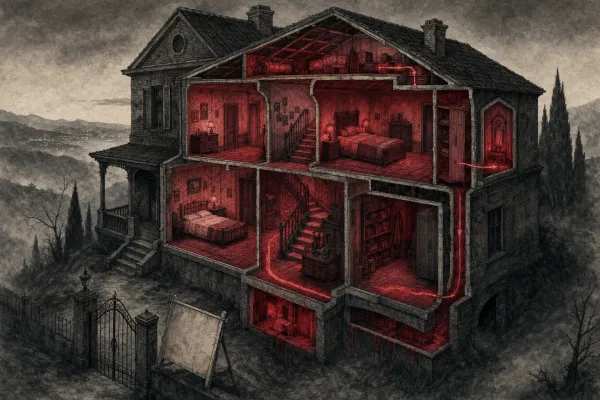
That's the shape the cases on this site take. They draw on the Chinese script-murder tradition rather than the Western party-kit one, which shows up in specific ways: long cases (80 to 180 minutes, not 20), architectural and mechanism-driven puzzles, and reveals that are as much about the family behind the crime as about the method. The Fox Mask, Magic Square Manor, Black Sheep Manor and Eight Coffins sit squarely in the 硬核推理 and 机制本 traditions described above; Sweet Home and The Fourth Suspect are closer to 情感本, where the deduction is the delivery mechanism for the story rather than the point of it.
If you've played jubensha in Chinese and want to know what survives translation and what doesn't, that's the honest answer: the puzzle structure and the emotional architecture survive. The room, the host, and the liar sitting opposite you do not — and those are worth seeking out properly if there's a venue near you.
Frequently asked questions
How do you pronounce jubensha?
Roughly jü-ben-sha, with the first syllable close to the French u. In Mandarin it's jùběnshā — falling, falling-rising, level.
How long does a jubensha game take?
Four to six hours is standard, including 30–60 minutes of silent reading at the start and a long reveal at the end. Hardcore reasoning scripts can run longer. Comedy scripts sometimes come in under three.
Do I need to speak Chinese to play?
For most scripts, yes — booklets are long and clue puzzles are often language-dependent. English-language venues exist in several cities outside China, running translated and originally-written scripts. If there isn't one near you, a solo case in the same tradition is the accessible substitute.
Is jubensha the same as a murder mystery party?
No. The two share a premise and almost nothing else. Jubensha is longer, has a paid host, uses active clue-searching, and — the decisive difference — tells the killer that they're the killer, so one player spends the whole session deceiving the others. See the comparison table above, and our guide to hosting a Western-style murder mystery party for the other tradition.
Is it like Werewolf or Mafia?
Only the faction scripts (阵营本) are close. Social deduction games are built on almost no story and a repeated voting mechanic; jubensha is built on a written narrative, personal objectives, and evidence you physically go and find. The deduction in a good hardcore script is closer to a locked room mystery than to Mafia.
Where can I try something similar in English right now?
Search for "script murder" or "jubensha" plus your city — venues exist in the UK, Australia, Singapore, Canada and the US, and the number is growing. For something you can start in the next five minutes, browse the online cases; they're single-player adaptations of the same tradition, playable in a browser with no signup for the first case.