Whodunit, Howdunit, Whydunit: The Four Shapes of a Mystery
Published August 14, 2026 · 5 min read

Most people use "mystery" and "whodunit" interchangeably. They shouldn't. A whodunit is one specific structure among several, and the others are not variations on it — they withhold a different piece of information and therefore ask you to do a completely different kind of thinking.
Understanding which shape you're in is genuinely practical. It tells a reader what to pay attention to, tells a writer which questions the ending must answer, and tells a player what they're actually being asked to produce. Picking the wrong one is why some mysteries feel unsatisfying for reasons the reader can't name — usually because the book solved a question they weren't asking.
There are four core shapes.
1. The whodunit — identity withheld
The familiar one. A crime occurs, a bounded set of suspects exists, and the story withholds which of them is responsible until the end.
What's hidden: identity. What you do: eliminate. Build a grid of means, motive and opportunity, find the contradiction that breaks one alibi, and narrow. The characteristic pleasure: the reveal reframes everything you read. Details you registered as scenery become evidence.
The whodunit's defining requirement is the closed circle — the reader must believe the answer is on the page. Remove that and elimination becomes impossible, and the ending arrives as an announcement rather than a conclusion.
Its structural weakness is that it can be gamed from outside the text. Experienced readers narrow the field by narrative convention rather than evidence: the least likely suspect, the character with no scenes alone, the second-billed actor. When a reader guesses correctly by counting pages rather than by reasoning, the form has failed even though the answer was right.
2. The inverted mystery — nothing withheld
The reverse. The crime is shown at the start, including who committed it and how. The story is then about the detective closing the distance.
Sometimes called the howcatchem — a term coined by Philip MacDonald in the 1960s — or the reverse whodunit. Columbo is the canonical example, and the form goes back to R. Austin Freeman's Dr Thorndyke stories of the early twentieth century, which pioneered the two-part structure: crime first, investigation second.
What's hidden: nothing about the crime. What's withheld is the mistake — the flaw in an apparently perfect plan. What you do: watch for the error. You know everything the killer knows, so you're playing along with the detective, spotting the loose thread simultaneously. The characteristic pleasure: dramatic irony. You watch a confident criminal be slowly, courteously dismantled, and you can see the trap being built before they can.
The inverted form is criminally underused, and it has a real advantage over the whodunit: it can't be spoiled by guessing, and its tension is completely independent of surprise. It also lets you write the murderer as a full protagonist with interiority — impossible in a whodunit, where giving a suspect an inner life effectively clears them.
Its requirement is a specific, findable flaw. If the detective wins by intuition or by the criminal panicking, the form collapses, because the entire contract was that you would get to see the mistake.
3. The howdunit — method withheld
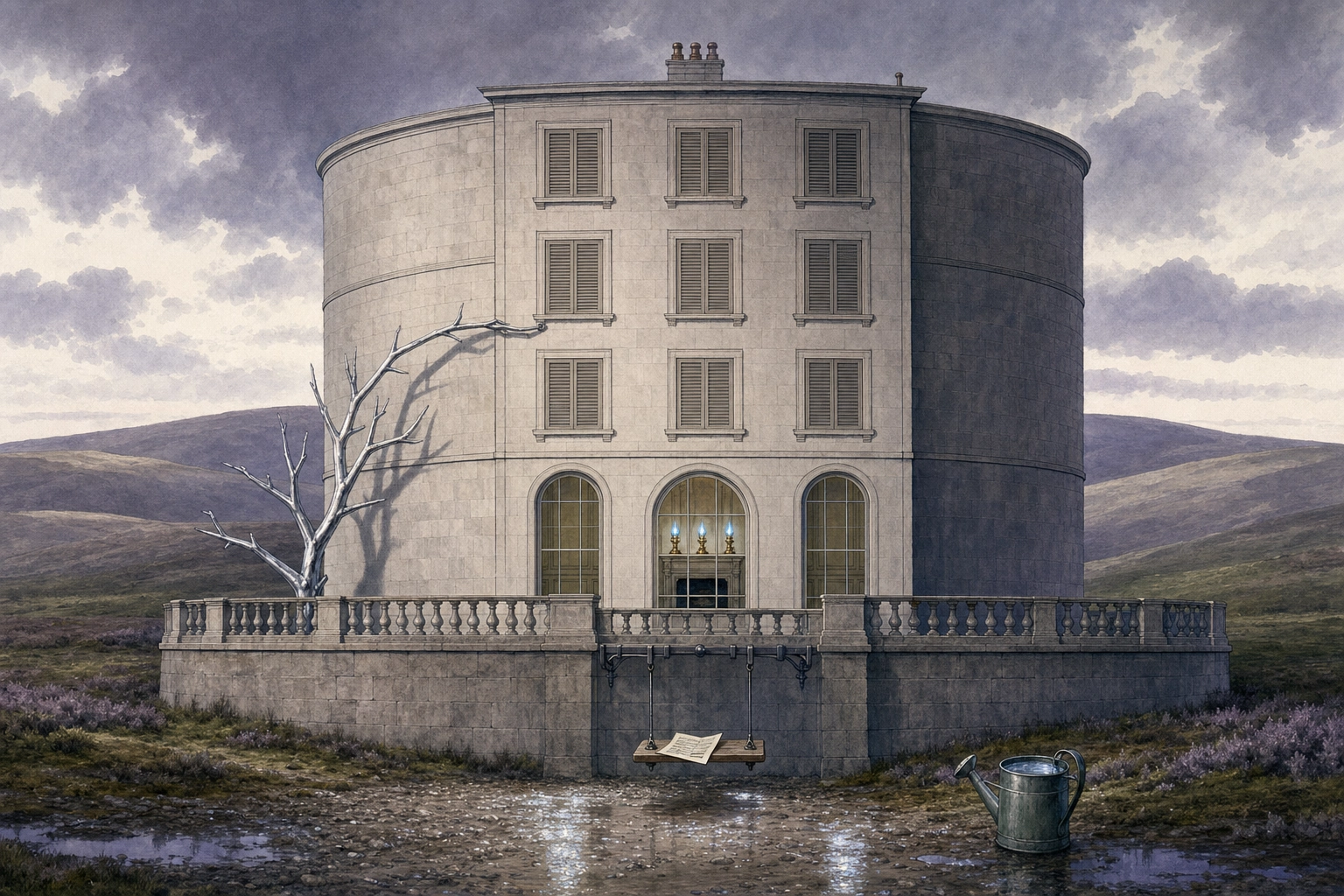
Identity may be obvious, or irrelevant. What's genuinely unknown is how the crime was physically possible.
What's hidden: mechanism. What you do: rule out the impossible. Reconstruct the physical scene, test each hypothesis against the constraints, and find the assumption you made without noticing. The characteristic pleasure: the click of a physical explanation snapping into place — the same satisfaction as a good engineering puzzle.
Every locked room mystery is a howdunit. So is any impossible crime: unmarked snow, a watched corridor, a victim poisoned at a table where everyone ate the same food. The Japanese honkaku tradition is built almost entirely on this shape, and it's the form with the strictest fairness requirement — the reader must have the complete physical facts, because that's the only material they have to work with.
Note that howdunits and whodunits often coexist, and the good ones use the method to reveal the identity: only one person could have known the room's true dimensions, so working out how tells you who.
4. The whydunit — motive withheld
The identity is known or quickly established. The method is clear. What's incomprehensible is the reason.
What's hidden: motive, and by extension the meaning of the whole event. What you do: excavate. The answer lies in the past — a decades-old event, a hidden relationship, an inheritance, a secret about identity or parentage. The characteristic pleasure: not a click but a reframe. The crime turns out to be the visible tip of something much older, and the reveal recontextualises the victim rather than the suspects.
Whydunits dominate contemporary crime fiction and Nordic noir, and they're the shape most likely to be genuinely moving, because the answer is about people rather than mechanisms. They're also the easiest to write badly: if the motive arrives as new information in the last chapter — an abuse, a swapped child, a buried accident that was never hinted at — the reader has been given nothing to work with and the ending is an assertion, not a solution.
The fair-play version plants the shape of the past throughout: an absence, an unexplained closeness, a photograph missing from an album, a date nobody mentions.
The four, compared
| Whodunit | Inverted | Howdunit | Whydunit | |
|---|---|---|---|---|
| Withholds | Identity | The killer's mistake | Method | Motive |
| Reader's task | Eliminate | Spot the flaw | Reconstruct | Excavate |
| Needs | A closed circle | A findable error | Complete physical facts | Foreshadowed history |
| Fails when | Guessable by convention | The detective intuits | An unmentioned passage | The past arrives unprepared |
| Reveal feels like | Reframing the cast | Watching a trap close | A mechanism clicking | Recontextualising the victim |
Most good mysteries are more than one of these. The strongest combination is usually howdunit plus whodunit — the mechanism identifies the person — because it makes the physical solution and the human solution the same act of deduction. The weakest is a whodunit with a whydunit reveal that wasn't seeded, which is the most common structural failure in modern crime fiction.
What this changes for readers
Diagnose the shape in the first quarter, then read accordingly.
In a whodunit, track claims and timings. Everything else is texture.
In an inverted story, stop trying to guess and start looking for the flaw. If you find yourself bored because "we already know," you've misread what's being withheld.
In a howdunit, draw the map yourself rather than trusting the one you're given. The trick almost always lives in a spatial or temporal assumption you imported.
In a whydunit, pay attention to what people don't say about the past. The clue is usually an absence — a relationship never explained, a year never mentioned.
What this changes for writers
Decide the shape before you outline, because it determines what your ending must do.
The most useful practical consequence: the shape tells you where your clues have to go. A whodunit needs clues distributed evenly across suspects. A howdunit needs the complete physical description early, when the reader is least suspicious of it. A whydunit needs the past seeded from the first act, or the ending is a cheat. An inverted story needs the mistake to happen on the page, visibly, in the opening sequence, so the reader can be ahead of the detective and enjoy being right.
If you're not sure which you're writing, ask what the final page has to answer. If it's "it was him," you're in a whodunit. If it's "and that's how he did it," a howdunit. If it's "and that's why," a whydunit. If your reader already knew all three, you needed an inverted structure and the tension has to come from the closing of the gap. More on construction in how to write a murder mystery.
What this changes for players
Interactive mysteries usually require you to submit an accusation, and the best ones ask for more than a name — killer, method, motive, and the evidence supporting each. That's a deliberate design decision: it forces you to solve all four shapes rather than the one you find easiest.
It's worth noticing which one you're naturally good at. Most players are strong at one and lazy about the others — they'll narrow the suspect list confidently and then hand-wave the mechanism, or reconstruct a beautiful physical solution attached to a motive they never bothered to establish. Scoring that separates the components tells you which muscle you're not using.
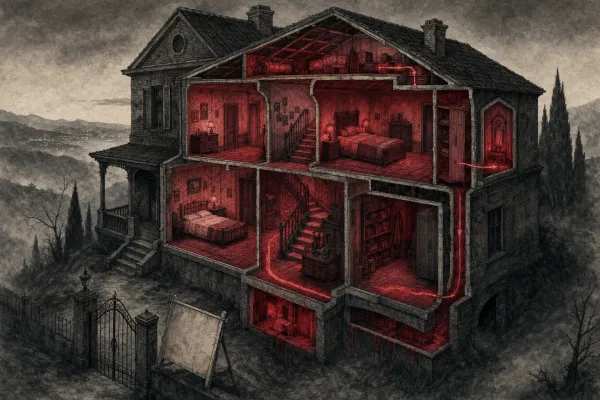
Among the cases here, Magic Square Manor and The House That Lies are pure howdunits built on spatial assumption. The Fourth Suspect is a whydunit wearing a whodunit's clothes. Snowbound Pursuit is a classical whodunit with four interlocking crimes. Browse the full list — the taglines usually give away which shape you're walking into.
Frequently asked questions
What is an inverted detective story?
A mystery that shows the crime and the criminal at the start, then follows the detective working out how to prove it. Also called a howcatchem or reverse whodunit. Columbo is the best-known example; R. Austin Freeman's Dr Thorndyke stories established the form in the early 1900s.
What's the difference between a howdunit and a whodunit?
A whodunit hides the identity of the culprit; a howdunit hides the method. Locked room and impossible-crime stories are howdunits. Many mysteries are both, and the strongest ones use the method to establish the identity — only one person could have done it that way.
What is a whydunit?
A mystery where the culprit and method are known or quickly established, and the real question is motive. The answer typically lies in the past, and the fair-play requirement is that the shape of that past is seeded throughout rather than revealed at the end.
Which type is hardest to write?
The whydunit, because the reveal has to be both surprising and prepared, and motive is much harder to foreshadow than a physical clue. The howdunit is hardest to write fairly — one unmentioned architectural detail invalidates the whole puzzle.
Are these the only kinds of mystery?
They're the four core structures by what's withheld. Plenty of other useful distinctions exist — cosy versus hardboiled describes tone, police procedural versus amateur sleuth describes the investigator, closed circle versus open field describes the suspect pool. Those are orthogonal to this: a cosy can be a howdunit, a procedural can be a whydunit.