Christmas Murder Mystery Party: Themes, Timings, Run Sheet
Published August 14, 2026 · 6 min read

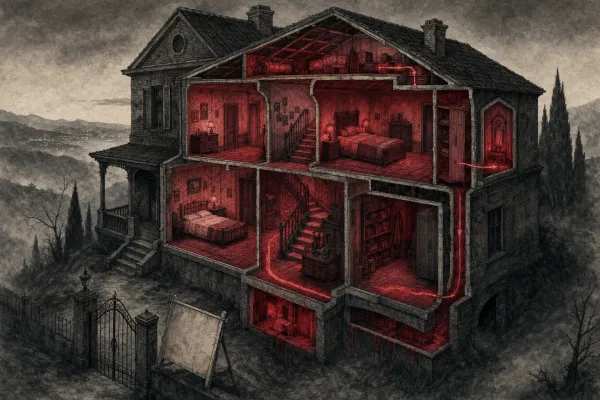
Christmas is structurally a murder mystery. A group of people who did not choose each other, sealed inside a house by weather and obligation, with long-standing grievances, unequal inheritances, too much alcohol and nowhere else to be. Golden Age novelists knew this — the country-house Christmas mystery is practically its own subgenre — and the reason it works in fiction is exactly the reason it works as a party.
The catch is that a Christmas mystery has constraints Halloween doesn't. Your guests span forty years of age. Half of them are related. Some have been drinking since two. Someone has to cook. This guide is built around those constraints rather than pretending they don't exist.
The three occasions, which need different games
"Christmas murder mystery" covers three very different evenings. Pick yours before you go further, because the right game for one is the wrong game for the others.
The family Christmas. Mixed ages, mandatory attendance, real history in the room. Needs: a game everyone can join, no requirement to perform, and absolutely no theme that maps onto actual family tension. Length: 90 minutes, not three hours — there's a meal happening.
The friends' festive night. Self-selected, similar ages, high willingness to dress up and commit to a bit. This is the one where a full scripted dinner mystery genuinely lands. Length: three hours.
The office party. A group with a power structure, varying enthusiasm, and at least three people who came under duress. Needs: teams rather than individual roles, no forced improvisation, and a hard finish time. Length: 60–90 minutes inside a longer event.
Most disappointing Christmas mysteries are a friends'-night game run at a family Christmas. The material isn't wrong; the occasion is.
Six festive themes
Each of these solves the "why can't anyone leave?" problem with something seasonally believable.
1. The snowed-in lodge
The road is closed, the phones are down, and the group booked this place months ago. Someone doesn't make it to breakfast.
The purest version of the closed circle, and the weather does all the plot work for you. Costume is easy (knitwear), the setting explains the isolation, and snow itself is a marvellous clue — footprints, timings, what was covered and when. Works for any of the three occasions.
2. The reading of the will, at Christmas
The family gathers at the estate for the first Christmas since the patriarch died. The solicitor arrives with the will. The solicitor does not survive dessert.
Enormous built-in motive for everyone, which means even reluctant players know what they want. Caution: do not run this at a real family Christmas if there has been a real inheritance. It is very funny right up until it isn't.
3. The office Christmas party
The party is winding down, the fire door was propped open, and the regional manager is found in the stationery cupboard. Everyone had a reason: the promotion, the restructure, the expenses, the thing at last year's party.
Ideal for a work event because the setting is the setting, no costume is needed, and satire gives shy colleagues cover to be broad without being embarrassed. Keep the fictional company obviously fictional.
4. The New Year's Eve countdown
Everything happens in the fifteen minutes before midnight. The lights go out on the count of ten; at zero, someone is dead. The whole mystery is a timeline puzzle inside a quarter of an hour.
Terrific for NYE because the structure gives you a natural climax at midnight — either solve it before the bells or spend the first hour of the new year arguing. Small casts (six to eight) and a very tight timeline.
5. The Victorian Christmas
Gaslight, a country house, servants and family, a locked study. Straight down the middle of the Golden Age tradition.
Highest atmosphere, highest costume effort. Best for the friends' night with a group who will genuinely commit. Pairs beautifully with a locked room structure.
6. The Secret Santa
Everyone drew a name. Every gift is a message. One of them is a threat, and by the time the gifts are opened the recipient is dead.
The cleverest low-effort theme on the list: the gift exchange is the evidence release. You can distribute physical clues as wrapped presents, which is both very easy and looks like enormous effort. Works at any of the three occasions and scales well.
Casting when half the room is family
Family groups break the standard casting advice, because the roles come pre-assigned by three decades of history. Adjust:
- Give the quietest person the most information, not the most lines. They'll be sought out all evening, which is participation without performance.
- Split people who always talk to each other. Siblings and couples will otherwise conduct one private conversation for two hours.
- Never give a character a trait that maps onto someone's real life. The bitter middle child, the one who's bad with money, the drinker. It is not a joke to the person it lands on, and the whole room will feel it.
- Give teenagers the fun roles. They're usually the most willing improvisers in the room and the most likely to be written off as spectators. A teenager handed a genuinely juicy secret will carry the entire game.
- Grandparents want to be included, not spotlit. A character who sits in an armchair holding the crucial fact is perfect, and they'll enjoy it far more than being made to stand up and act.
- Let someone opt out into being the detective. There is always one guest who will not play a character under any circumstances, and "you're the investigator" is a face-saving job that keeps them at the table.
The three-hour run sheet (and the 90-minute family cut)
| Time | Full version | Family cut |
|---|---|---|
| 0:00–0:20 | Arrivals, drinks, character packs | Arrivals; hand out cards at the table |
| 0:20–0:35 | Premise read aloud; character introductions | Premise only, kept to five minutes |
| 0:35–0:45 | The murder; closed circle declared | Same |
| 0:45–1:30 | Round one: investigation, first evidence | Round one, 25 minutes |
| 1:30–1:50 | Break — food, drink, second evidence released | Serve the course; release evidence with it |
| 1:50–2:35 | Round two: theories harden, confrontations | Round two, 25 minutes |
| 2:35–2:50 | Written accusations | Written accusations |
| 2:50–3:00 | Reveal and scoring | Reveal |
The one rule that matters at Christmas: set the finish time and announce it at the start. Family gatherings have a hard stop imposed by children, elderly relatives, or the last train, and a mystery that overruns and never reaches its reveal is much worse than no mystery at all. If in doubt, cut round two, not the reveal.
On alcohol: run the game earlier than feels natural. A mystery that starts at 9 p.m. on Christmas Eve competes with six hours of wine and loses. Late afternoon into early evening, before the heavy drinking starts, is the reliable slot — and it fills the dead hours between lunch and the evening, which is exactly when Christmas gatherings sag.
The office version
Corporate holiday parties need a different design, because attendance is semi-compulsory and the hierarchy doesn't switch off.
Use teams, not individual characters. Four to six teams of three to five, all working the same case competitively. This removes the single biggest problem — nobody has to perform alone in front of their boss — while keeping the competitive energy that makes work events actually fun.
Cap it at 90 minutes inside the larger event, with a scoreboard and a clear ending. Open-ended games at office parties dissolve.
Avoid workplace-mirroring plots. A fictional company with a fictional restructure is funny. A murder motivated by a promotion, three weeks after a real promotion round, is not. Choose the snowed-in lodge over the office party theme if your organisation has had a difficult year.
Have a genuine role for the sceptics. Every office has three people who will not role-play. Make them the judging panel, the evidence custodians, or a team of their own. Given a job, they usually turn out to be the most competitive people in the room.
Our virtual team building guide has the remote-office version, including agendas for groups over twenty.
Scattered family: the remote version
The holidays are the single most common time people want to play together from different countries, and video-call mysteries have a specific failure mode: cross-talk. Eight people on a call cannot investigate simultaneously, because only one person can speak.
What works:
- One shared case, one screen shared, one driver. The host shares a case, reads aloud, and types what the group decides to ask. Everyone else argues. This is far more robust than eight individual character roles over video.
- Rotate the driver every fifteen minutes, so nobody spectates for an hour.
- A shared document for the timeline, visible to everyone. Remote groups lose track of chronology much faster than in-person ones.
- Watch the time zones before you plan. A three-hour game across a seven-hour spread means someone is playing at 2 a.m. and will not enjoy it. Either shorten to 75 minutes or run an asynchronous version over two days.
The technical setup is covered in running a mystery on Zoom or Discord.
Doing this with no preparation at all
December is the worst possible month to take on a four-week prep project. If you want the evening without the production, run the investigation format instead: no characters, no costumes, no scripts. One case on a screen, the room solving it together, arguing about who's lying.
It fits Christmas better than it fits any other occasion, for three reasons. It includes the people who won't role-play. It works with whatever headcount actually shows up. And it can be started ten minutes after someone says "shall we do something?", which is how these evenings really begin.
For seasonal atmosphere, Snowbound Pursuit is the obvious pick — fireworks over a frozen river, four crimes in one night, and a scarf that ties them together. Eight Coffins is a classic manor puzzle with one trail up and none down. The Seventh Guest is a masked-gathering mystery that suits a New Year's Eve crowd. Browse the full list and let the room pick by tagline.
For a two-person Christmas — and plenty of people have one — the couples format splits the roles into interviewer and note-taker, which turns a solo game into a genuinely shared one.
Frequently asked questions
When should I send out characters for a Christmas party?
At least two weeks ahead, and expect December to eat your timeline — people are busier and read less. Send the character brief with the invitation rather than separately, include a one-line costume suggestion, and follow up two days before with a single-sentence reminder of who they're playing.
What's the best Christmas murder mystery for a family with kids?
Run the investigation format with a case the adults find genuinely interesting, and give the children specific jobs: evidence keeper, timeline scribe, official question-asker. Children are much happier with a real job in an adult game than with a watered-down version of their own. Our family guide and kids' party guide go further on age bands.
How do I run one at a New Year's Eve party?
Use the countdown theme and time the reveal to just before midnight. Announce a hard deadline — accusations in by 11:45 — because a deadline that coincides with an actual, externally-imposed one produces genuinely good pressure. Keep it to six or eight players; NYE parties have too much ambient noise for a large cast.
Is a Christmas murder mystery worth doing for just three or four people?
Yes, and it's often better. Small groups get through evidence faster, everyone talks, and nobody hides. A shared case for three people is more satisfying than a twelve-character script run with four. See murder mystery games for small groups.
What if half the guests have never done one before?
Say so at the start and set one rule: you may lie about why you did something, never about where you were. That single constraint gives beginners a clear, safe way to be interesting without needing to invent a whole performance, and it keeps the timeline solvable.